Thursday, August 30, 2007

Already it is the Future!


Here is a wonderful old propaganda film by none other than General Electric from the Prelinger Archives depicting the history of electricity in the United States. A great study of propaganda in general and a frightening/inspiring look at what GE was trying to accomplish back in the day, including a list of modern household, agricultural and industrial innovations, and possible new realms of electricity generation (they mention that home atomic generators probably won't be developed and they talk about harnessing the energy of the sun through photosynthesis).

I wonder a bit about the significance of the fact that the word communism is never actually used, so that the freedom from tyranny line seemed to me to come out of left field with no overt enemy. I suppose back then it really wasn't necessary to spell it out, however. Everyone knew that it was the domino effect we were afraid of, but I think it's an interesting manifestation of the way the Cold War was fought, in this underhanded, irrational, unspoken kind of way.

Look! Already it is the Future! Here is greater freedom from drudgery than ever before! Today Freedom and Power are inextricably linked. But now our freedoms are threatened by forces that would crush our liberties and tyrannize the minds of men. Against these forces we have the weapons of Freedom, Courage, Faith and The Creative Spirit. And we have the tool that built our way of life: Productivity. With this productivity we can add to our freedoms and defend them (this is accompanied by an image of an infinite stream of war planes).

Double points if you decide to watch a newer piece of propaganda from the same company... Ah! The evolution of propaganda from the cosiness of your own Personal Computer.

Thursday, August 23, 2007

Remembrance of Things Past


Conde Nast has done something quite wonderful: they're opening up the classic photo archive of House & Garden and selling the prints. While magazine photography has always been looked down upon by the art world, I've always been captivated by those glossy pages. And, in retrospect, the spreads are works of art; photographers like Andre Kertesz, Horst P. Horst and Cecil Beaton made their mark. Check out their store; it's like a who's who of classic design, with portraits of Aldous Huxley and Alfred Hitchcock, as well as shots of "An Elegant Tea" and "Leisure Furniture Heads for the Sun" (above). There's something absolutely magnificent about the head-on collision of dated parties and utterly timeless moments.

Wednesday, August 1, 2007

Clip-On Earrings


I have a ton of old clip-on earrings that I've either inherited from my great-grandmother or collected from junk sales (I can't shake the desire to be prepared for playing dress-up with ten-year-olds at a moment's notice). I recently came up with a new way to use them in the everyday, though. If you were giving someone money or just like to keep money in a drawer (I like to stash a little in case I can't get to an ATM) you can use clip-on earrings as a money clip. Depending on the sturdiness of the earrings, you can only do a few bills at once.

Monday, July 30, 2007

my prince of Egypt: an expression

In 1982, Mr. Bergman announced that he had just made his last theatrical film — it was “Fanny and Alexander,” a look at high society in a Swedish town early in the last century that was in part inspired by his own childhood.

“Making ‘Fanny and Alexander’ was such a joy that I thought that feeling will never come back,” he told Ms. Kakutani. “I will try to explain: When I was at university many years ago, we were all in love with this extremely beautiful girl. She said no to all of us, and we didn’t understand. She had had a love affair with a prince from Egypt and, for her, everything after this love affair had to be a failure. So she rejected all our proposals. I would like to say the same thing. The time with ‘Fanny and Alexander’ was so wonderful that I decided it was time to stop. I have had my prince of Egypt.”


—taken from the New York Times' obituary of Ingmar Bergman

Tuesday, July 17, 2007

The notation of spaces and objects by frequency?

I found the RESONANCE OF THE SINK! I was doing dishes, and singing to myself, and all of a sudden, one note just rattled my skull, it was really loud, and I could hear it all through my face! (The frequencywas properly re-inforced by the shape etc. of the sink as I was leaning over it.)

My favourite contemporary composer, Maryanne Amacher talks about the size of sound in various mediums, and composes what she calls Third Ear Music, sound that exploits the hearing mechanism's tendencies at certain intervals to interpret tonal information as spatial information. She claims that in this process, the inner ear is caused to vibrate and also emit sound. Made up of specific combinations of intervals, it sounds like a rotating tone in your ear, and is different depending on where you stand in the room, or even how you move your head! Whatever is happening (I've been trying to get to the bottom of it for ages) it is truly an amazing experience. Although a lot of her work is difficult to document on cd, there are a few Third Ear pieces on an album called Sound Characters on tthe Tzadik label.

This is what I want to be an expert in. The notation of spaces by frequency.

P.S. I just heard about a festival in Scottland, called, (drumroll), Resonant Spaces, that takes place in various locations selected specifically for their unique acoustics. Ranging from an oil rig to cliff caves by the sea, the festival features different artists who focus on the physical properties of sound in their work. Guess you'll know where to find me next year...

http://www.arika.org.uk/resonant-spaces/what/?

Thursday, June 21, 2007

Stilgoe


Here's a flickr set of the port of oakland as seen from the ferry ride between Alameda and San Francisco (I take it most every day to get to work and Arwen takes it quite often to come visit). Goods movement is not the greatest thing for the planet, mostly because the ships that sail internationally are not regulated (too hard to enforce?), but it is fascinating and I am learning about it over time. Stilgoe (Arwen's professor from back in the day) says that one can learn a lot from looking at the place around you and asking questions. In this way I have learned (among other things): where Monrovia is and why it is called Monrovia, which bird is a coot and which is a grebe, which shipping company is the biggest in Hawaii, and I have watched over months some of the process of steel recycling at Schnitzer Steel (my favorite because of an old sign they have by the side of the channel that shows a crocodile munching on three cartoon cars).

Friday, June 15, 2007

Drip irrigation


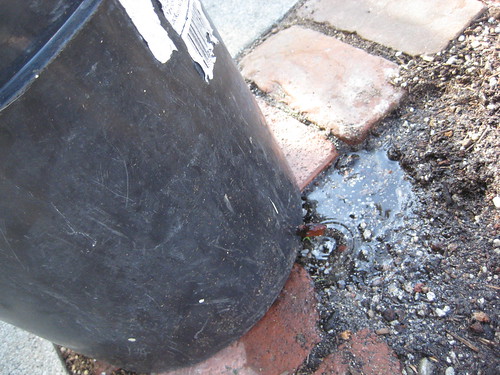
I saw this in the neighbor's yard—a very cheap drip irrigation system. This way the water has time to soak deep into the soil and you don't have to stand there watering for an hour a drip at a time or have all the topsoil get hard or run off. All you do is drill out a hole in a plastic bucket, put a stick through the hole and then fill the bucket with water so that moisture seeps out slowly through the cracks and fibers.